
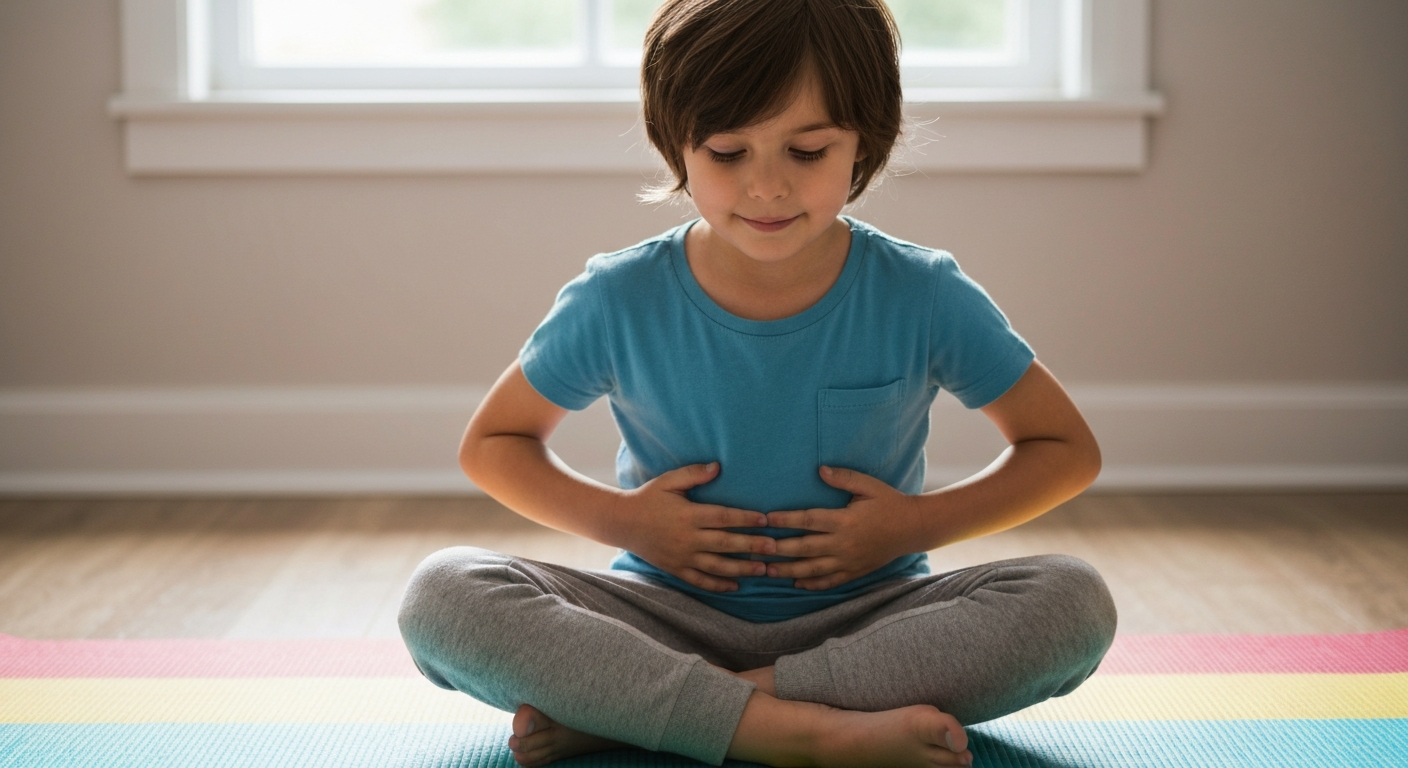
Why Breathing Exercises Work for Kids
There’s a reason “take a deep breath” is essentially universal parenting advice — because it works. And not just as a cliché. Deep, intentional breathing activates the vagus nerve and the parasympathetic nervous system, physically shifting the body out of fight-or-flight mode and into a calmer state. Heart rate slows. Cortisol drops. The brain’s thinking center (prefrontal cortex) comes back online.
The beautiful thing? Kids can learn these techniques. Even very young children (as young as 3-4) can use simple breathing exercises with a little practice and playful framing. The key is making it feel like play, not like medicine — and practicing during calm moments so the skill is available when things get hard.
Here are 8 breathing exercises that kids will actually do — and that genuinely help.
8 Breathing Exercises for Kids
1. Belly Breathing (Dragon Breath)
This is the foundation — deep diaphragmatic breathing that gets the whole torso involved. Most kids (and adults) breathe shallowly in the chest, which actually maintains tension rather than releasing it. Belly breathing is the remedy.
How to do it: Have your child lie down or sit comfortably and place both hands on their belly. Breathe in slowly through the nose and watch the belly rise like a balloon filling with air. Then breathe out slowly and feel the belly fall. Repeat 5-6 times. Call it “dragon breath” and they might even want to breathe fire on the exhale.
2. Flower and Candle Breathing
This is the all-time classic for young children because it’s so visual and concrete — perfect for ages 3-6. The metaphor does the work for you.
How to do it: Hold up one hand as if it’s a flower. Slowly breathe in through the nose to “smell the flower.” Then hold up a finger as a “candle” and breathe out slowly through the mouth to “blow out the candle.” The slow exhale is what activates the calming response, so encourage a long, slow out-breath. A Breathe Like a Bear book is a wonderful companion to introduce these techniques.
3. Box Breathing (Square Breathing)
Box breathing is used by Navy SEALs to regulate under extreme stress — and it works just as well for a 7-year-old melting down before a big test. The structure provides something concrete to focus on, which interrupts anxious thought spirals.
How to do it: Breathe in for 4 counts. Hold for 4 counts. Breathe out for 4 counts. Hold for 4 counts. Repeat 4 times. For a visual, trace the sides of an imaginary square with a finger (one side per phase). Older kids love this because it feels official and “serious.”
4. Star Breathing
A beautiful variation of box breathing that appeals to kids who are visual and tactile. All you need is a hand and a finger.
How to do it: Spread one hand out like a star. Use the index finger of the other hand to trace up each finger (breathe in) and down each finger (breathe out). By the time you’ve traced all 5 fingers, you’ve taken 5 deep, regulated breaths. Simple, self-contained, and can be done anywhere — in the car, in line at school, under the table at a restaurant.
5. Bumble Bee Breathing (Humming Breath)
This one is especially effective for kids who carry tension in their face and jaw — and for the kiddos who find silence hard. The vibration from humming creates a calming resonance in the body.
How to do it: Breathe in deeply through the nose. On the exhale, close your lips and hum like a bumble bee — a long, low “hmmmmm” until your breath runs out. Kids often giggle the first time, which is completely fine (laughter is also a great nervous system regulator!). Do it 5 times. Some kids like to plug their ears to feel the vibration more.
6. Balloon Breathing
A wonderful visualization-based technique for children who are imaginative. It’s belly breathing dressed in delightful imagery.
How to do it: Ask your child to imagine their belly is a deflated balloon. Breathe in slowly and watch the balloon inflate (arms spread wide if they like). Pause at the top, then breathe out slowly and watch the balloon slowly deflate (arms come back in). The visual of expanding and contracting helps children regulate the pace of their breath naturally. You can even make balloon color choices part of the exercise for extra buy-in.
7. Lion’s Breath
This one is specifically designed to release tension — especially for kids who are holding in frustration or anger. It’s a bit dramatic, which is exactly why children love it.
How to do it: Breathe in deeply through the nose. At the top of the breath, open the mouth as wide as possible, stick out the tongue, open the eyes wide, and breathe out with a big “HAAAA” sound. Do it 3 times. It feels ridiculous and that’s the point — the combination of exertion and silliness breaks the tension cycle. Also a great one to do together; it’s hard not to laugh.
8. 4-7-8 Breathing
This technique, popularized by Dr. Andrew Weil, is particularly effective at the transition points of the day — before sleep, before a stressful event, or during a homework session that’s going sideways. It’s best for children 7 and older who can reliably count to 8.
How to do it: Breathe in through the nose for 4 counts. Hold for 7 counts. Breathe out slowly through the mouth for 8 counts. That long exhale (twice as long as the inhale) is what shifts the nervous system most powerfully. Even two rounds of this can measurably reduce anxiety and heart rate. Keep a mindfulness card deck for kids with the technique illustrated so children can reference it independently.
Tips for Teaching Breathing Exercises to Kids
- Practice during calm times, not just crisis moments. If breathing exercises only appear when things are hard, they become associated with punishment or trouble. Practice at bedtime, during snack, or as a fun activity.
- Do them together. Your participation makes it fun and models the skill. “Let’s do 5 dragon breaths together.”
- Keep it short. 3-5 breaths is usually enough to create a shift. You don’t need 10 minutes of meditation.
- Let them teach you. When kids teach a technique to a parent, sibling, or stuffed animal, they solidify their own learning and feel proud of the skill.
- Name the technique. “Want to try star breathing right now?” gives a concrete invitation that children can eventually self-initiate.
Creating a Breathing Practice Habit
The most effective way to make breathing exercises a genuine tool in your child’s toolkit is to build them into daily life. Some families do 3 belly breaths before every meal. Others do star breathing during the bedtime routine. Even 60 seconds a day is enough to wire the neural pathways that make these techniques available under stress.
You don’t have to do all 8. Pick one that resonates with your child’s personality and practice it consistently for a week. Then add another. Over time, your child will have a whole toolkit of self-regulation strategies they chose themselves — and that’s one of the greatest gifts you can give them.
Related Reading
- Calming Techniques for Kids with Anxiety
- 15 Calm Down Corner Ideas for Kids
- How to Stop Toddler Tantrums: What Actually Works
